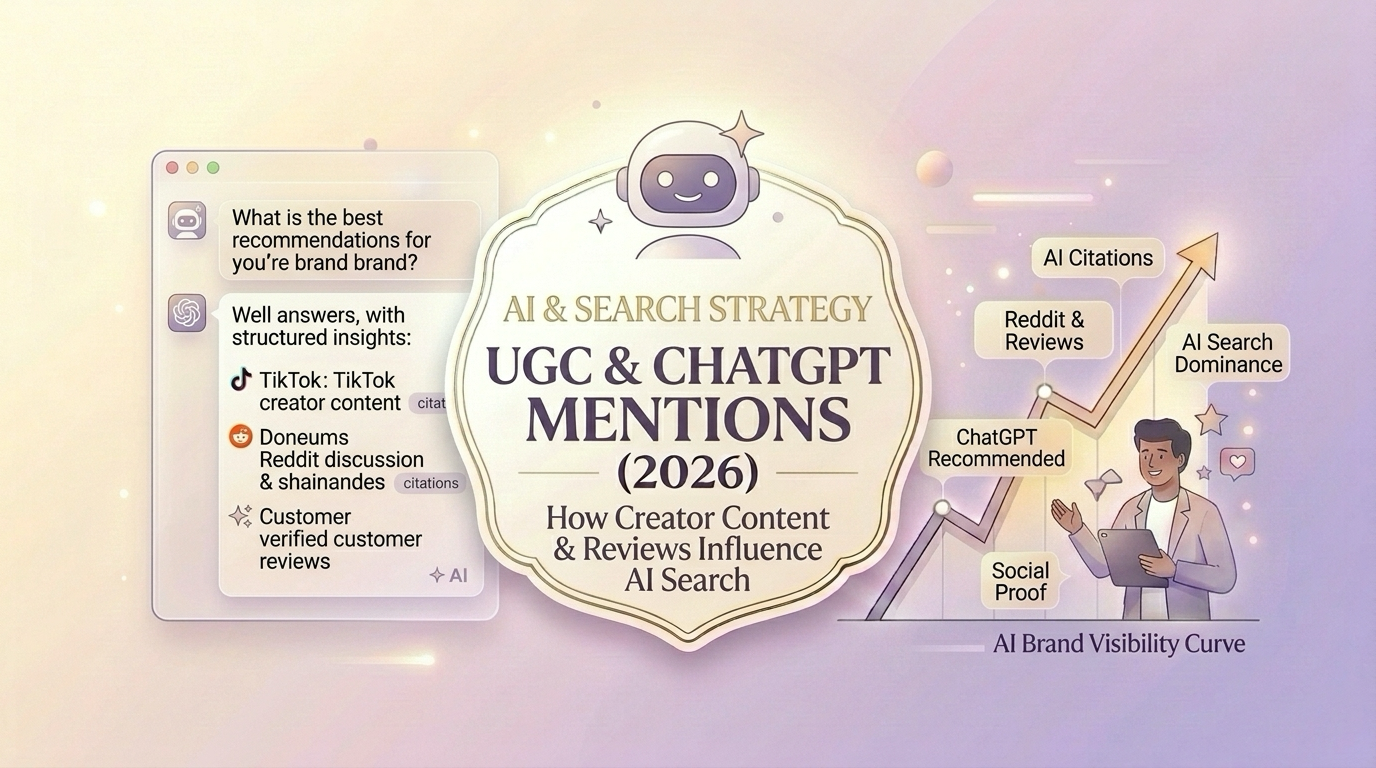
Yes, UGC can potentially contribute to your brand's visibility in ChatGPT, but not because ChatGPT has a specific 'UGC ranking signal'.
The more interesting part is what happens when customers and creators start talking about your brand outside your own website.
Reviews, creator videos, Reddit discussions, product experiences, tutorials, and other third-party content can give AI systems more information about what your brand does, who it's for, and how people actually use it.
When ChatGPT uses web search, it can retrieve current information from public websites and cite those sources in its answers. When it isn't searching, its responses come from information learned during training.
So UGC isn't a button you press to get your brand mentioned.
It can, however, help build the wider online footprint that AI systems use to understand brands.
How does ChatGPT decide which brands to mention?
There isn't a public formula that tells us exactly why ChatGPT mentions one brand and leaves another out.
There are, however, two important ways information can make its way into an answer.
1. Information the model already knows
When ChatGPT answers without web search, it's working from information it learned during training.
That means your brand may already be represented in the model's knowledge through websites, publications, reviews, discussions, and other online content that existed within its training data.
2. Information retrieved from the web
When ChatGPT Search is used, it can pull information from current web sources and cite them in its response.
This is where your off-site presence becomes particularly interesting.
If someone asks:
"What are some good skincare brands for sensitive skin?"
ChatGPT may search for relevant information and use pages it finds to build its answer.
Your own product page is one possible source.
But so are other pages that talk about your product.
That's where UGC comes into the picture.
Where does UGC fit into ChatGPT visibility?
Think about everything that can exist online about your brand.
Your website might say:
"Our moisturizer is lightweight, fragrance-free, and designed for sensitive skin."
That's useful.
But imagine there are also:
- Customers reviewing the moisturizer
- Creators demonstrating how they use it
- Reddit users discussing whether it worked for them
- Beauty bloggers comparing it with other moisturizers
- YouTubers showing it as part of their skincare routine
- Customers answering questions about the product
- Creators explaining who they think the product is best suited for
Now there are multiple independent descriptions of your product.
They're not all saying the exact same thing, either.
They're creating context around the brand.
And that matters because AI search isn't limited to reading what brands say about themselves. ChatGPT Search can retrieve information from across the public web when answering questions.
Can ChatGPT use UGC as a source?
Potentially, yes, but where the UGC lives matters.
Publicly accessible content can be discovered and retrieved in ways that private or temporary content can't.
For example:
| UGC | Potential AI visibility |
|---|---|
| Public product review | Potentially useful |
| Public Reddit discussion | Potentially useful |
| Public creator blog post | Potentially useful |
| Public product comparison | Potentially useful |
| Public YouTube video/page | Potentially useful |
| Instagram post | Depends on accessibility and retrieval |
| Private social post | Very limited |
| Disappearing Story | Limited |
| Content behind a login | Limited |
This doesn't mean every public piece of UGC will be picked up by ChatGPT.
It means public, relevant content creates an opportunity for your brand to exist in more places than just your own website.
And that distinction is important.
Not all UGC is equally useful for AI visibility
Getting 100 creators to post:
"I love this product!"
isn't necessarily going to do much for how clearly an AI system understands your brand.
Compare that with content that actually provides context:
"I've been using this moisturizer because most heavy creams make my skin feel oily. This one is lightweight and works well under makeup."
The second example tells someone much more.
It connects:
brand → product → problem → audience → use case → experience
That's useful information for anyone researching the product, including an AI system trying to answer a specific question.
What types of UGC can contribute to AI visibility?
Customer reviews
Reviews can explain what people actually like, dislike, or use your product for.
They can also introduce language that your brand might not use on its own website.
For example, customers might describe a product as:
- Good for travel
- Easy to layer
- Better for beginners
- Good under makeup
- Useful for a specific hair type
Those real-world descriptions add context.
Creator reviews
Creators can go beyond simply showing the product.
A useful creator video might demonstrate how the product works, explain who it's for, compare it with another product, or show how they incorporate it into a routine.
Tutorials
Tutorials are particularly useful because they connect a product with a specific use case.
A makeup creator showing three ways to use your product creates a different kind of information from a simple product shot.
Comparisons
Comparison content puts your brand into a category.
For example:
"Brand A vs Brand B: Which moisturizer is better for oily skin?"
That tells an AI system something very different from:
"Here's our new moisturizer."
Community discussions
Reddit and other public communities can contain detailed conversations about products, alternatives, problems, and experiences.
They can also reveal the language real customers use when talking about a product.
Does having more online content increase brand visibility in ChatGPT?
Not automatically.
This is where the idea can easily get taken too far.
You shouldn't think:
More UGC → more mentions → more ChatGPT visibility.
There's no evidence for a simple formula like that.
A better way to think about it is:
More useful third-party content → more information available about your brand → more opportunities for AI systems to encounter that information.
Whether that information actually affects an answer depends on things like the query, the source, whether the content is accessible, and whether it's relevant to the answer being generated.
Recent third-party analyses of ChatGPT citations have found meaningful representation from community and other independent sources, although the exact source mix varies by study and query.
So the goal isn't to create the most UGC.
It's to create UGC that gives people, search engines, and AI systems something useful to understand about your brand.
How to create UGC that gives AI more context about your brand
This is where brands can actually do something useful.
Instead of giving creators a brief that says: "Make a video about our product."
Give them a reason to talk about the product.
Ask them to explore things like:
Who is this product for?
A creator can explain who they think would benefit from it.
What problem does it solve?
This connects the brand to the problem people are actually searching for.
How do you use it?
Demonstrations and tutorials create useful product context.
What makes it different?
Creators can explain differences they noticed between your product and alternatives.
When would you use it?
This connects your product with specific situations and use cases.
What was your experience?
First-hand experiences give the content substance beyond a brand description.
The important thing is that you shouldn't script every word.
Give creators the information they need, then let them explain the product naturally.
A better way to think about UGC for AI search
Instead of asking: "How many pieces of UGC do we need?"
Ask: "What questions do people have about our product, and are other people answering them online?"
That's a much more useful question.
Say you sell a travel backpack.
People might be asking:
- Is it good for budget travel?
- Does it fit under an airplane seat?
- Is it comfortable for long walks?
- Is it good for digital nomads?
- How much can it actually hold?
- How does it compare with a carry-on suitcase?
You could create UGC around those exact questions. Now you're not simply generating more brand content.
You're creating third-party answers to the questions potential customers already have.
UGC mention vs. ChatGPT citation: what's the difference?
These two things are easy to confuse.
A brand mention simply means ChatGPT names your brand in its answer.
For example: "Some options include Brand A, Brand B, and Brand C."
A citation is a source attached to information in the answer. In ChatGPT Search, users can open citations to inspect the underlying source.
So a brand can be mentioned without being directly cited.
And a source can be cited even when the brand isn't the main subject of that source.
That's why tracking only whether your brand name appeared isn't enough. You also want to understand where ChatGPT got the information from.
How can you monitor your ChatGPT mentions?
You don't need to ask ChatGPT one question and call it a day.
Build a small set of prompts around the questions your customers actually ask.
For example, if you're a skincare brand, track prompts such as:
"What are the best moisturizers for oily skin?"
"What skincare brands are good for sensitive skin?"
"What are some affordable alternatives to [competitor]?"
"What moisturizer would you recommend for someone who wears makeup every day?"
Then record:
- Was your brand mentioned?
- Where did it appear?
- Was it recommended or simply mentioned?
- Was there a citation?
- Which sources were cited?
- Were any UGC or community sources included?
- Which competitors appeared?
Run the same prompts regularly rather than relying on one-off checks.
That's important because AI responses can change depending on the query and whether web search is used.
So, can UGC actually help your brand get mentioned in ChatGPT?
It can help, but indirectly.
UGC isn't a secret ranking lever for ChatGPT. You can't simply pay ten creators to post about your brand and expect ChatGPT to start recommending you.
What UGC can do is expand your brand's presence beyond your own website.
A useful creator video can explain your product. A customer review can describe their experience. A Reddit discussion can introduce your brand into a comparison.
A tutorial can connect your product to a specific use case. Together, these create a larger body of third-party information about your brand.
And as AI search systems increasingly retrieve information from the wider web, having useful information about your brand in more than one place gives those systems more context to work with.
So don't create UGC just to get mentioned by ChatGPT.
Create UGC that answers the questions your customers are already asking.
If that content is public, useful, and discoverable, you're giving your brand more opportunities to show up wherever those customers are looking, including AI search.